 Tabor Mountain
Life Saving AI Technology
Leveraging artificial intelligence, machine learning, predictive analytics, and augmented reality to proactively, and in real time, detect a variety of emergencies and generate emergency egress plans.
Our patents will change the security and fire business worldwide over the next 20 years

Clarus Emergency Egress Technology
The June 2023 article of SecurityInfowatch.com:
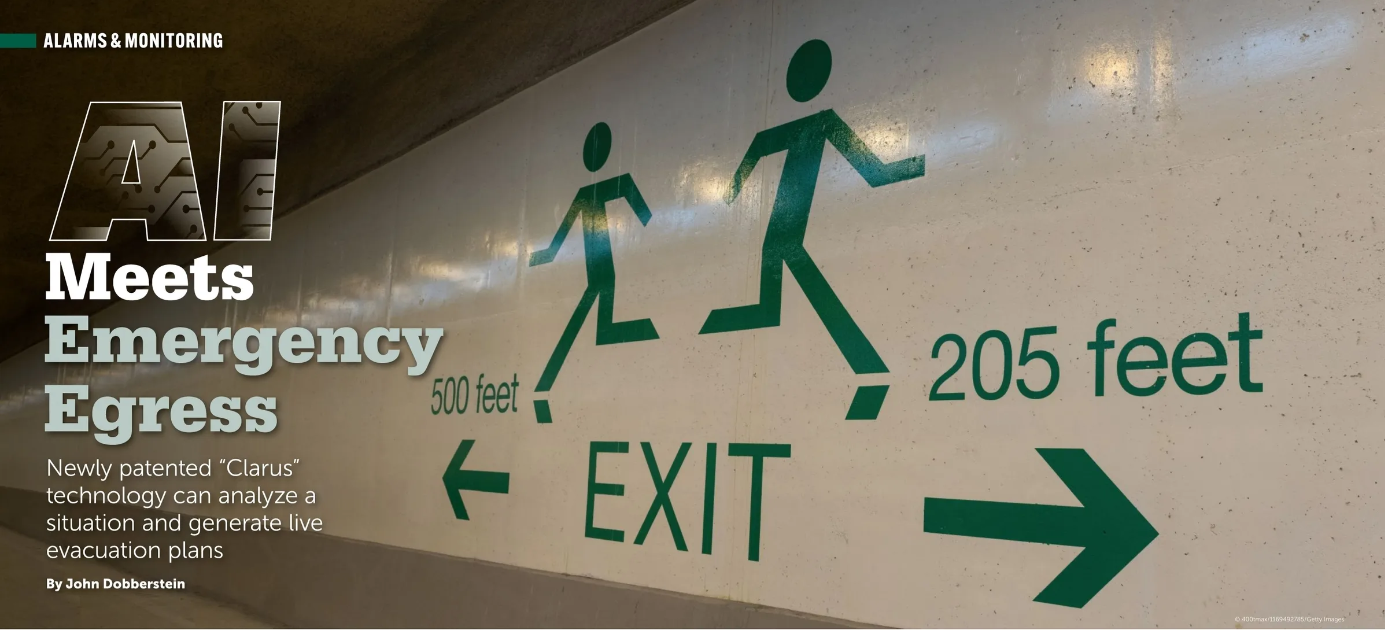
The emergence and accessibility of artificial intelligence technology is changing the security industry at a breathtaking pace, which means there is no shortage of new innovations. In that regard, a group of investors at Delaware-based Tabor Mountain LLC have patented technology leveraging the power of AI that they say could shake up the alarm industry – changing the way police and firefighters respond, or train for, a variety of emergencies. And it may also save countless lives, they say. The new technology, called “Clarus,” leverages AI, machine learning, predictive analytics and augmented reality to proactively, and in real-time, detect a variety of emergencies – such as fire, personal safety, active shooters, lockdowns, and other potential threats – and generate emergency egress plans. The technology would also identify ways to help users reach safety through using configurable and distributed output devices – such as wall switch plates, smoke detectors, carbon monoxide detectors – located throughout a building. The devices collect a variety of signals, such as changes in decibel or other audio levels, temperature, smells or odors, movement, motion and/or images or videos – all of which can be assessed by the AI engine to determine emergency response strategies. The devices would provide emergency response instructions via voice guidance prompts, lighted visual instructions case on walls, floors, doors or windows, augmented-reality visuals cast on surfaces, and instructions presented on users’ mobile devices via text messages and push notifications. Clarus could also provide improved training methodologies for responding to different types of emergencies in different types of private and public spaces.
Integration Possibilities
Clarus is described as a suite of different devices and sensors and processors, or computing systems, that communicate wirelessly via Wi-Fi or other means in home and building networks. The sensor devices can include individual sensor components, which can sense the surrounding conditions, including light, sound, temperature, motion and more. Conditions detected by the sensors can be processed to determine whether there is an emergency in a building, home or other environment. The sensors can also include output devices, which can be audio or visual, including speakers and lighting systems that can project arrows or other types of cues or instructions on the floor, doors or other places to guide occupants out to safety. Chloe Margulis, a New Yorkbased attorney who is representing the group, says the technology can be integrated into existing building systems that would be able to communicate to the Clarus devices to determine an egress strategy, and the type and gravity of emergency. Margulis says the software can implement AI techniques and models that have been trained to learn a structure and arrangement of a building and different types of habits of building occupants – such as where users typically spend most of their time or what hallways they take. “By learning this sort of information, the system can, over time, figure out what the best route is for a particular user to exit the building in an emergency,” Margulis says. “For example, we know a particular user in a particular room has a disability. Based on their prior routes...Clarus can automatically determine how to tell that user to egress.” As sensor devices detect where occupants are in a building, the system can output instructions in a specific room. Instructions and notifications could also be displayed on mobile devices as well.
Modeling Scenarios
Some “augmented reality” tools can be used to communicate egress routes by casting them onto a wall, door or the floor. If a user is identified as having a handicap, such as being blind, their instructions might be sent as audio cues provided by the sensor devices in the room or outputted by their personal device. Margulis says the system also determines the severity of the emergency to determine if a person should leave their position or stay in place to ensure their safety in the moment, adding that the technology is built so it can communicate the nature and gravity of an emergency automatically with fire and police departments, informing them of where the emergency is located, where the occupants are, and whether they are moving or sheltering in place. “Clarus is able to model the building and essentially determine many different and possible scenarios in which emergencies may occur, and how users from different rooms in that building layout would potentially be able to egress in simulated scenarios,” Margulis says.
Active Shooter Response
The AR technology in Clarus could offer crucial help to law enforcement in the event of an active shooter in a building, Margulis says. One example would be generating an image of police officers at the end of the hall, meant to influence the shooter’s behavior and potentially protect occupants in a particular room. The technology and improved availability of information could help alert officers to where an active shooter is in a building or help police clear rooms faster through awareness of occupants in the building and their locations. According to Bill Delmonico, who is listed on the Clarus patent and serves as president of Minn.-based EII Fire and Security, many gunshot detection systems have sensors that detect an event and set off an alarm, but do little more. “The key thing is [Clarus] can tell us where the gunman is before they get there,” Delmonico says.
Looking for Partners
Delmonico says the Clarus technology was developed with the help and advice of people in the firefighting and law enforcement profession, and he sees major alarm companies or perhaps even technology providers like Dell or Google being players. He says Tabor Mountain is looking to participate in a joint venture, sell the patents, or find some other type of sales agreement to leverage the technology in the security market, adding that ideally, Tabor Mountain wants to find a company with distribution in residential and commercial sectors. The software has yet to be formally written, and Delmonico is hoping to find a partner that can put several engineers on the task for a year or more to get it written. “These patents were developed to save lives,” Delmonico told Security- InfoWatch. “Especially in the shooter detection area, if we went and had this developed with the software, any school in America might buy this system. So it is a once-in-a-lifetime chance for the alarm business to have something that nobody else has.” Delmonico says he had discussions with some security industry vendors at ISC West earlier this year but he didn’t receive any commitments, which he believes is a sign executives are having trouble visualizing the technology’s abilities. He believes property managers for condominiums and apartments would also have an interest in the technology because it will integrate with the fire system they already have. “Insurance companies believe a burglar takes a little, and fire takes all. They know that,” Delmonico says. » John Dobberstein is managing editor of SecurityInfoWatch.com.
» John Dobberstein is managing editor of SecurityInfoWatch.com.
The entire content from the above article was taken from SecurityInfoWatch.com